
Things in LA That Aren't Haunted But Are Still Scary


Venice Ballerina Clown
Location: Main Street & Rose Avenue, Venice
Since 1989, a 30-foot-tall clown in a tutu has stood above the corner of Main Street and Rose Avenue. Created by artist Jonathan Borofsky to capture Venice's eccentric, theatrical personality, the sculpture has long divided public opinion.
Its motorized right leg originally performed a slow kicking motion, but the mechanism was disabled following noise complaints before briefly being reactivated in 2014. The CVS beneath it has since closed, but the clown remains.
El Bordello Alexandra Apartments
Location: 20 Westminster Avenue, Venice
A block from the Venice Boardwalk stands a seven-unit apartment building covered in gargoyles, dragons, winged figures, and a towering centaur. The property is rumored to have operated as a brothel around the turn of the 20th century, although the story hasn't been conclusively documented.
In the early 2000s, owners Tony Wells and Brittany Stevenson transformed the building into an elaborate artistic residence. Its theatrical appearance has inspired everything from secret society rumors to comparisons with a Tim Burton film.
Johnie's Coffee Shop
Location: 6101 Wilshire Boulevard, Miracle Mile
At the corner of Wilshire and Fairfax sits a diner that looks like everyone walked out one day and never came back. Opened in 1956, Johnie's is a classic example of Googie architecture, the futuristic style popular during LA's postwar era. The restaurant closed in 2000, but much of its interior remains frozen in time, with vintage counters, furnishings, and equipment still in place.
Despite sitting at one of LA's busiest intersections, the diner has remained closed to regular customers for more than 25 years. Its abandoned-looking appearance has made it a popular filming location, including for Miracle Mile, a 1988 film about an impending nuclear catastrophe. The building was designated a Los Angeles Historic-Cultural Monument in 2013.
Chicken Boy
Location: North Figueroa Street, Highland Park
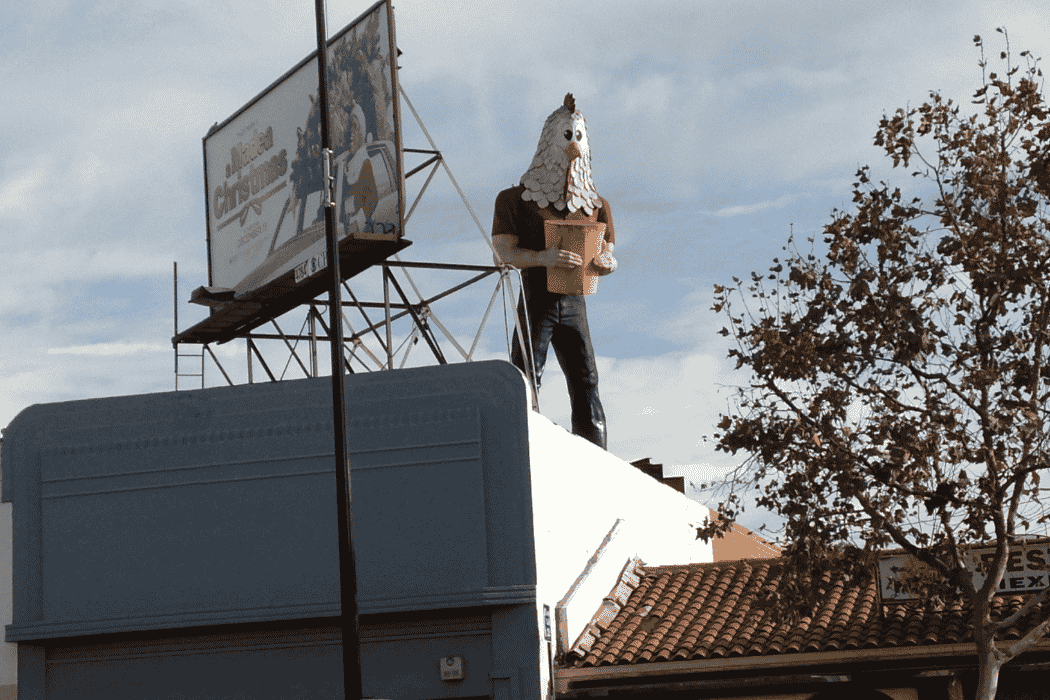
Los Angeles has its own Statue of Liberty. He's 22 feet tall, has the body of a man, the head of a chicken, and holds a bucket of fried chicken.
Created in the 1960s to advertise a Downtown LA restaurant, Chicken Boy was adapted from a Muffler Man, one of the enormous fiberglass figures once used in roadside advertising. When the restaurant closed in 1984, graphic designer Amy Inouye rescued the statue and kept it in storage for more than two decades before installing it above her Highland Park studio in 2007.
Today, he's a beloved neighborhood landmark, affectionately known as the Statue of Liberty of Los Angeles.
Hollywood Character Costumes at Night
Location: Hollywood Boulevard
For decades, costumed street performers have posed as superheroes, movie villains, and cartoon characters for tourist photographs along the Hollywood Walk of Fame.
During the day, the costumes blend into the souvenir shops, tour buses, and general spectacle. After dark, when the crowds thin out, a slightly faded Spider-Man walking alone down the sidewalk or a masked movie villain standing beneath a streetlight takes on an entirely different quality.
Link to Yelp (yes, they have a Yelp).
The Stop-Sign Entrances to the 110 Freeway
Location: Arroyo Seco Parkway, Pasadena to Downtown LA
When the Arroyo Seco Parkway opened in 1940, it was considered a revolutionary achievement in American transportation. One of the country's earliest freeways, it connected Pasadena to Downtown Los Angeles and helped establish the blueprint for modern highway travel.
Designed for an era of slower automobiles, several original entrances feature stop signs and extremely short acceleration lanes, requiring drivers to merge into fast-moving traffic from a complete stop. The parkway's designation as a National Historic Landmark makes major redesigns especially complicated.
The Fashion District After Dark
Location: Downtown Los Angeles
For more than a century, Downtown LA's Fashion District has been a center of garment manufacturing, wholesale commerce, and textile shopping. During business hours, its streets are crowded with shoppers, vendors, and delivery trucks.
But many businesses close in the late afternoon, leaving colorful storefronts concealed behind metal security gates. Entire blocks that were bustling just hours earlier become noticeably quiet, with shuttered warehouses and largely empty streets creating a stark contrast to the daytime activity.
Link to a scary story from LA Fashion District.
Scientology Buildings
Location: Hollywood
The enormous blue complex on Fountain Avenue has a history that predates its current occupants. Opened in 1930 as Cedars of Lebanon Hospital, it once treated Hollywood celebrities, including Marilyn Monroe and Mae West, before becoming part of Cedars-Sinai Medical Center.
The Church of Scientology acquired the property in the 1970s and transformed it into its Pacific Area Command Base, commonly known as "Big Blue." The organization also owns other prominent Hollywood properties, including the historic Celebrity Centre on Franklin Avenue.
The complex's imposing architecture, security features, and restricted areas, combined with the organization's reputation for secrecy, have made it a subject of public curiosity.
Circus Liquor Clown
Location: 5600 Vineland Avenue, North Hollywood
Since 1959, a 32-foot-tall neon clown has stood outside Circus Liquor at the corner of Vineland Avenue and Burbank Boulevard. Created during Southern California's era of oversized roadside advertising, the sign features an exaggerated grin, distinctive eyes, and brightly illuminated details.
Originally intended as cheerful advertising, its appearance has become unsettling to some passersby, particularly at night. The landmark also appeared in the 1995 film Clueless, during the scene in which Cher is abandoned by her date and subsequently robbed outside a liquor store.
The City of Vernon After Dark
Location: Vernon, Southeast LA
Founded in 1905 as one of the first exclusively industrial cities in the country, Vernon was built for factories, warehouses, and manufacturing rather than residential life. Today, the 5.2-square-mile city is home to more than 1,800 businesses and roughly 50,000 jobs, but only a few hundred residents.
After dark, its sprawling warehouses, industrial plants, railroad tracks, and largely deserted streets create an atmosphere unlike almost anywhere else in LA. With so few homes, restaurants, or pedestrians, entire stretches can feel strangely uninhabited, even as factories continue operating behind closed doors.


